0
-
An empty cart
You have no item in your shopping cart


In the current wave of automotive intelligence and electrification, safety, as a core guarantee of fundamental performance, is being redefined. A certain automotive intelligent safety component company, deeply rooted in the field of passive safety, focuses on core products such as airbags. Faced with the challenges of surging orders, complex materials, limited space, and fragmented information, the company urgently needs to break free from traditional manufacturing models and use intelligent methods to solve the dual problems of production and logistics, comprehensively improving delivery efficiency and operational levels.
1. Unclear Tasks, Low Collaboration Efficiency
The disconnect between production planning and execution, unclear task assignment processes, and insufficient understanding of task priorities and resource scheduling by on-site personnel lead to low collaboration efficiency, slow response, and disruption to the overall production line rhythm.
2. Chaotic Order Management, Increased Delivery Risks
The lack of a unified order management and traceability mechanism results in delayed order status updates and a disconnect between material preparation and shipment schedules, affecting delivery accuracy and customer satisfaction.
3. Inventory Backlog and Severe Resource Consumption
Due to inefficient material flow and a mismatch between replenishment and consumption, the inventory structure is unbalanced, resulting in both redundant raw materials and stagnant finished products. This not only occupies a large amount of warehouse space but also increases management and operating costs.
To resolve these challenges, the company partnered with Yufeng Intelligent to create a smart factory project that integrates raw material storage, production line manufacturing, and material handling and distribution.
The core equipment of this project includes an automated storage and retrieval system (AS/RS), a conveyor system, and a PTL (Power Delivery Link) picking system. Material distribution is completed collaboratively by CTUs (Customer Units) and stealthy omnidirectional AGVs, achieving unmanned operation for material picking and loading. Product shipment works in conjunction with an automated packaging system, ensuring comprehensive information sharing and data traceability from raw material, semi-finished product, and finished product warehousing to auxiliary material loading and unloading. By strengthening data integration, full-process automation, and full-scenario digitalization, the factory’s internal digital and visual management has been achieved, effectively improving the client’s operational efficiency and decision-making accuracy, and helping them move towards intelligent and efficient development.
In response to rising raw material prices and persistently high labor costs, the trial picking process faced numerous challenges, such as human error and low picking efficiency. To address these issues, Yufeng Intelligent designed and implemented a solution combining a PTL (Power Tolerance) light-up picking system with a CTU (Content Tolerance Robot) bin robot, helping to reduce human picking errors and improve overall operational efficiency.
This system offers several advantages: real-time updates to inventory and picking tasks, ensuring timely material delivery; flexible response to production plans, adapting to changing orders and scheduling; and support for full-process data tracking, providing strong support for optimizing production processes and inventory management, and promoting lean operations.
● Key Challenges and Solutions ●
Challenge 1: Effectively Controlling Costs While Meeting Customer Needs
Solution:
To meet the customer’s cost reduction requirements, the project selected a variable-track stacker crane, which can operate flexibly across multiple aisles, significantly reducing equipment investment while prioritizing efficiency.
Challenge 2: Achieving Enhanced Storage Efficiency and Seamless Information Management within Limited Space
Solution:
Given a fixed factory layout, limited height, and narrow workshop aisles, Keslon Intelligent optimized its multi-functional zoning layout to improve storage capacity and operational efficiency, while maximizing the integration of information management pathways.
● To address the storage needs of large quantities of materials, a raw material roll warehouse and intelligent warehouses for semi-finished products and auxiliary materials were introduced, replacing traditional manual stacking and flat storage methods, resulting in a significant increase in unit capacity.
● The interconnectedness of conveyor lines, elevators, AGVs, stacker cranes, and other equipment throughout the factory floor enables real-time replenishment and storage of multiple materials between production lines and warehouses, automating the connection between various process nodes and driving a major transformation in overall factory efficiency!
Challenge 3: Large Raw Material Size
Solution:
● Addressing the large size of fabric rolls (3.2 meters long and weighing up to 1 ton), Keslon Intelligent custom-developed a non-standard, omnidirectional, stealthy AGV to automate the handling of fabric rolls. This solution offers greater flexibility and mobility, effectively reducing factory layout costs, improving space utilization, and ensuring safe and deformation-free material handling.
● In the automated storage and retrieval system (AS/RS), Yufeng Intelligent simultaneously customized the stacker crane fork structure to precisely adapt to the characteristics of the fabric rolls, ensuring efficient and stable system operation.
Challenge Four: Diverse Carrier Specifications
Solution:
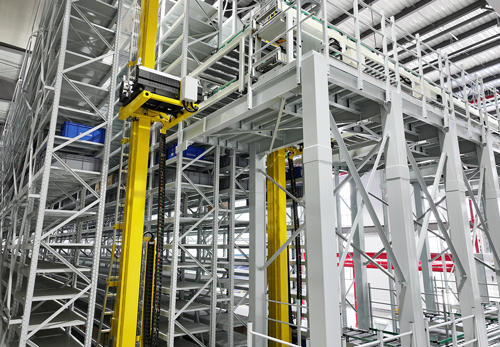
Addressing the coexistence of various sizes of bins and cartons within the factory, and to meet the intelligent logistics and lean management needs of large-volume, multi-category semi-finished and finished products in warehousing and circulation, Keslon Intelligent adopted a bin-type stacker crane AS/RS solution, achieving a significant increase in unit storage capacity.
The stacker crane used in this solution employs a double-extension adjustable clamping telescopic fork, possessing excellent flexibility and adaptability. It can automatically adjust the extension length according to the specifications of different bins and cartons. Through collaborative operation with aerial logistics equipment such as elevators and conveyors, it further optimizes material transportation routes within the plant. Combined with Keslon Intelligent’s independently developed WMS, WCS, and EFMS systems, it achieves end-to-end data connectivity and information closure across the entire “people, machine, material, method, and environment” chain, comprehensively promoting the deep integration and implementation of intelligent logistics systems and lean management models.
Faced with the challenges of intelligent transformation and upgrading for automotive parts manufacturing enterprises, Keslon Intelligent tailored an intelligent logistics solution for this company, successfully breaking through spatial, material, and information bottlenecks. It achieved automated collaboration and information connectivity across the entire warehousing-production-distribution chain, significantly improving operational efficiency and delivery assurance rates, and accelerating its move towards a new level of lean operation.