

Applications of Automated Warehouse Systems in the Automotive Industry
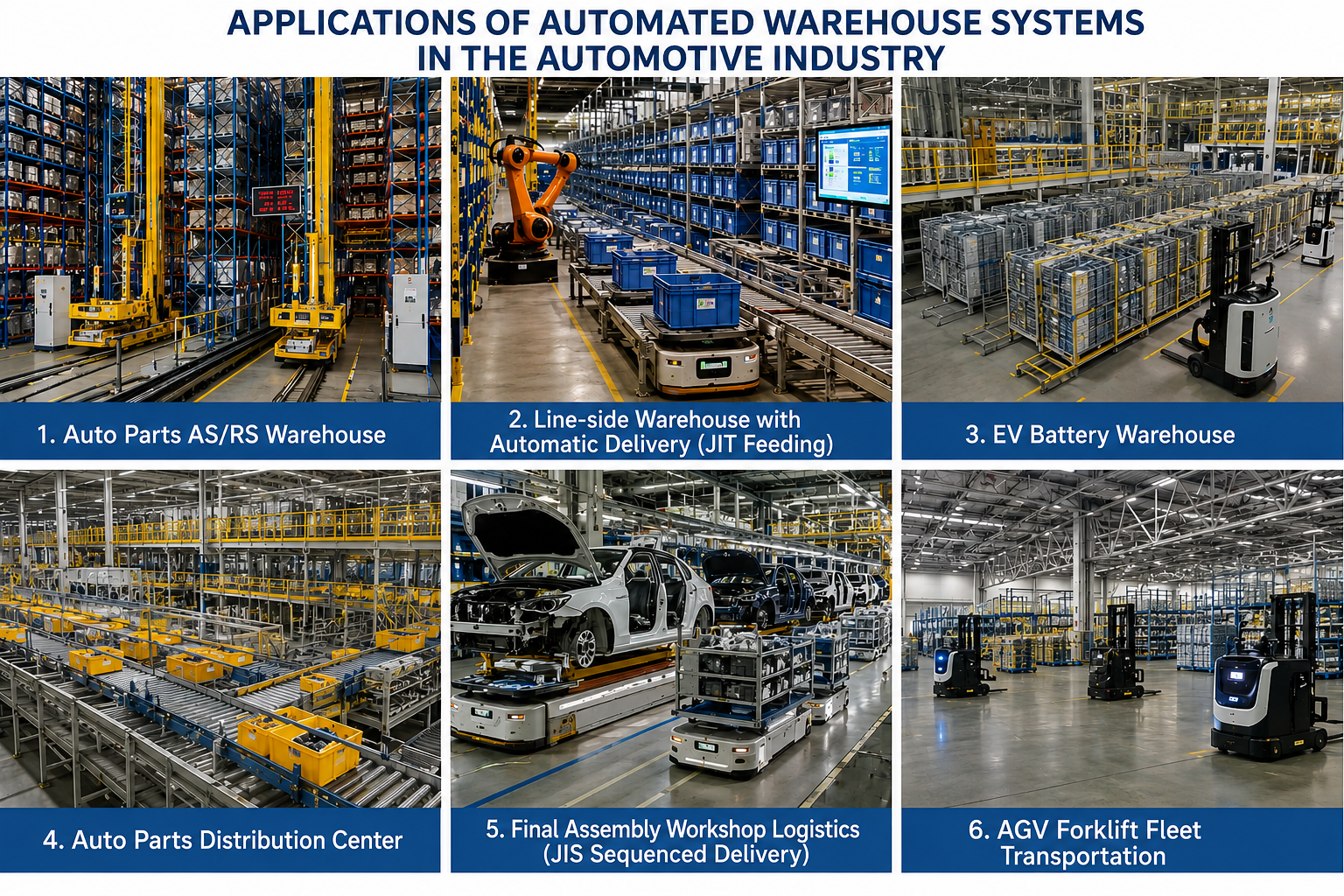
As the automotive industry continues to evolve toward Smart Manufacturing, Industry 4.0, and Digital Factories, Automated Storage and Retrieval Systems (AS/RS) have become a critical component of modern automotive manufacturing plants and auto parts facilities. Automated warehouse systems enable efficient management of raw materials, components, work-in-process (WIP), and finished goods, helping manufacturers improve productivity, reduce operating costs, and ensure supply chain reliability.
1. Why Does the Automotive Industry Need Automated Warehouses?
The automotive industry faces several logistics challenges:
Massive numbers of SKUs and components
Strict production scheduling requirements
Just-In-Time (JIT) manufacturing
Just-In-Sequence (JIS) 配達
Mixed-model production alongside mass manufacturing
Large warehouse space requirements
Complex and labor-intensive inventory management
Automated warehouse systems provide intelligent storage, automatic material handling, and real-time inventory management to support efficient automotive production.
2. Major Applications of Automated Warehouses in the Automotive Industry
2.1 Automotive Parts Warehouses
Used for storing:
Engine components
Transmission components
Chassis parts
Brake system components
Electrical system components
Electronic parts and modules
Typical equipment includes:
AS/RS stacker crane systems
Four-way shuttle systems
Miniload systems
AGV autonomous forklifts
Benefits:
High-density storage
Fast retrieval and storage
Accurate inventory management
Complete batch and traceability control
2.2 Line-Side Warehouses
Automated warehouses directly connected to production lines.
Main functions:
Automatic replenishment
Automated material delivery
Real-time inventory monitoring
JIT material supply
Equipment includes:
AGV transport robots
AMR autonomous mobile robots
Conveyor systems
Vertical lifting systems
Benefits:
Reduced production downtime risk
Lower inventory levels
Improved manufacturing efficiency
2.3 Battery Warehouses for New Energy Vehicles (NEVs)
Suitable for storing:
EV battery cells
Battery modules
Battery packs
Characteristics:
High-value products
Strict safety requirements
Precise temperature and humidity control
Typical solutions:
AS/RS automated warehouses
AGV material handling systems
Intelligent fire protection systems
Environmental monitoring systems
Benefits:
安全性の向上
Full product traceability
Reduced manual handling risks
2.4 Automotive Parts Distribution Centers
Serving:
Automotive OEM manufacturers
Aftermarket suppliers
Global spare parts supply chains
Characteristics:
Tens of thousands of SKUs
High-volume order processing
Fast delivery requirements
アプリケーション:
Multi-level shuttle systems
Automated sorting systems
Automatic packaging systems
Benefits:
Faster order fulfillment
Improved customer satisfaction
Reduced operational costs
2.5 Assembly Line Logistics
Applied to:
Engine delivery
Seat delivery
Tire delivery
Dashboard delivery
Main equipment:
AGV autonomous forklifts
AMR mobile robots
Conveyor systems
特徴:
JIS sequence delivery
Automatic scheduling
Real-time tracking
3. Common Automated Warehouse Solutions for the Automotive Industry
解決 1: AS/RS Stacker Crane Warehouse
Suitable for:
Engine manufacturing plants
Central parts warehouses
Vehicle assembly plant logistics centers
特徴:
Heights exceeding 45 メートル
High storage density
Fully automated operation
解決 2: Four-Way Shuttle System
Suitable for:
Multi-SKU component warehouses
New energy vehicle parts warehouses
特徴:
Flexible expansion
Rapid deployment
High storage density
利点:
30%–50% increase in storage capacity
Short return-on-investment period
解決 3: Miniload Automated Warehouse
Suitable for:
Small automotive components
Electronic parts
Fasteners and hardware
特徴:
High-speed storage and retrieval
Automated order picking
Precise inventory management
解決 4: AGV Autonomous Forklift System
Suitable for:
Internal factory logistics
Raw material transportation
Production line feeding
利点:
24/7 continuous operation
Autonomous navigation
Automatic charging
4. Benefits of Automated Warehouses for Automotive Manufacturers
Item Improvement
Warehouse Space Utilization 3–5 times higher
Labor Costs Reduced by 40%–70%
Inventory Accuracy ≥99.9%
Logistics Efficiency Improved by 2–5 times
Order Response Speed Increased by over 50%
Production Downtime Risk Significantly reduced
Supply Chain Visibility End-to-end transparency
5. Typical Configuration of an Automotive Automated Warehouse
A modern automotive automated warehouse project typically includes:
Automated storage racks
AS/RS stacker crane systems
Four-way shuttle systems
Conveyor systems
AGV autonomous forklifts
AMR mobile robots
Vertical lifts
Automated sorting systems
WMS (Warehouse Management System)
WCS (倉庫管理システム)
MES